
2026 Political Conference brings educators and candidates together


Over 500 educators attended Education Minnesota’s Political Conference, which took place on the last weekend of January in Bloomington. The conference, which occurs every other year and traditionally marks the start of campaign season, provided members with the opportunity to hear from elected officials and candidates, learn more about Education Minnesota’s 2026 election work and build skills to engage their colleagues in the electoral process.
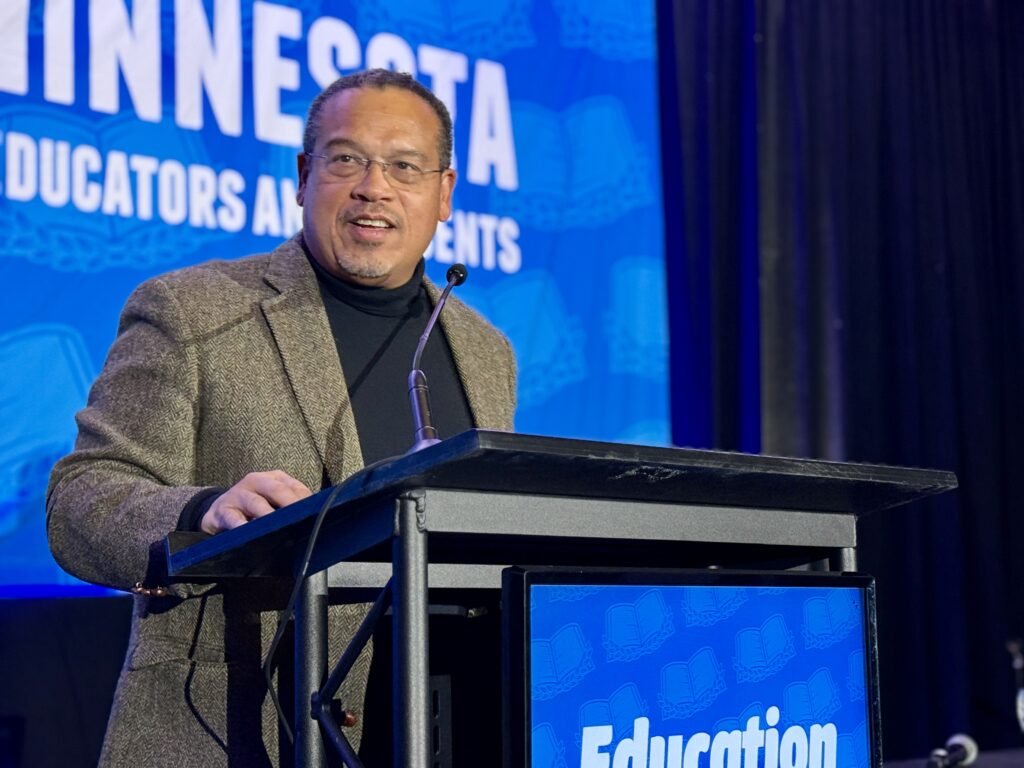
On Friday night, attendees heard from Minnesota Attorney General Keith Ellison. Attorney General Ellison thanked educators for the work they do and spoke about ICE presence in the state, outlining the actions his office has taken to protect Minnesota schools and communities, including several lawsuits against the federal government. “It doesn’t matter whether you teach history or civics…no matter what you teach, by your example, you teach our kids good citizenship,” he said. He ended his remarks by encouraging participants to mobilize their communities to vote to send a message about what we value as a state. “Pledge to show the highest turnout we’ve ever seen to send the message that Minnesota is free, sovereign and ready to stand up for every Minnesotan—no exceptions.”
Gov. Walz then addressed participants, thanking educators for their commitment to their students and communities, especially during the federal occupation. “I don’t know how to express the gratitude I have for Minnesotans…people who don’t want any credit other than to serve this country, to serve democracy and to serve humanity,” he said. He encouraged members to remain politically engaged and keep up the pressure to protect programs like Paid Family Medical Leave and universal school meals.
The evening concluded with a Senate candidate forum. Rep. Angie Craig and Lt. Gov. Peggy Flanagan, who are both running for U.S. Senate, answered questions from members on a range of issues including ICE activity’s impact in schools, special education, higher education and health care.
Saturday’s workshops included an overview of the Local Election Assistance Program (LEAP), volunteer recruitment, effective messaging for elections and then targeted trainings for Worksite Action Leaders and Get Out the Vote Leaders. The LEAP program is how the Education Minnesota PAC supports affiliates who wish to get involved in their local elections, such as levy referenda or school board. The roles are slightly different, but both WALs and GOTV leaders are member volunteers whose goal is to increase political participation and voter turnout to strengthen their local affiliate’s political power.
Over lunch, attendees participated in a conversation with Sen. Amy Klobuchar, who announced her candidacy for governor a few days before the conference. Members shared stories from their classrooms and then Sen. Klobuchar was invited to address the group and talk about her campaign.
Roseville teacher Job Nyangacha shared a story of conversations he’s had with students in his fifth-grade classroom, where he asked them what they would want elected officials to know about how ICE’s presence has made them feel. Responses included, “I don’t know why this is happening,” and “hate can’t take out love, but love takes out hate. So use more love” He praised educators that have “gone above and beyond” for their students and emphasized the need for ICE to leave the state so that students can learn and feel safe.
Margaret Citta, a West St. Paul high school counselor and a parent, spoke about Minnesota’s paid family leave law, sharing her experiences with pregnancy and maternity leave before the law’s implementation. She spoke about her first pregnancy, in which the baby was stillborn and she had to return to work a week postpartum, in order to preserve her sick days for future pregnancies, “Despite being careful with my sick days and spacing my children three years apart, I only took eight and nine weeks with my two living children. Minnesota Paid Family and Medical Leave gives all Minnesotans, educators included, the time they need to properly heal and return to work ready to focus on work,” she said.
Osseo ESP president Michelle Dennard spoke about ESP wages, describing how many of her workdays start at 3:50 a.m. because she goes to her second job before school starts in the mornings—something she has done for 22 years, because her ESP salary alone is not enough to provide for her family. “My story is not an anomaly. It is the lived reality of far too many ESPs in Minnesota,” she said. “Many hourly employees receive government assistance because they cannot make ends meet on their salaries. Many ESPs are on state insurance because they cannot afford district insurance while also paying their bills. And many ESPs work longer than they’d like to because they do not receive a pension that will support them in retirement.”
John Wolhaupter, president of Anoka Hennepin Education Minnesota, spoke about how skyrocketing health care costs have wreaked havoc on AHEM educators, costing many members hundreds of extra dollars per paycheck and making premiums unaffordable for many members as well. He described how the local prepared to go on strike over the astronomical health care increases and how the strike was narrowly averted hours before it was scheduled to begin. “While we were able to negotiate increased contributions to health insurance costs in our contract this time, that path is not sustainable. We can’t be on the verge of striking every two years. That is not fair to educators. That is not fair to the students and communities we serve,” he said.
Sen. Klobuchar then spoke briefly to attendees about her campaign and indicated her plans to pursue the Education Minnesota PAC’s endorsement process, which has specific requirements for gubernatorial candidates to ensure they get as much face-to-face interaction with our members as possible before receiving our PAC’s endorsement. To help members better understand which candidates we believe will further our organizational goals, Education Minnesota endorses in several political races. Federal endorsements are made through the National Education Association and American Federation of Teachers’ PACs, with the Education Minnesota PAC serving in an advisory capacity, providing recommendations to the national affiliates after member engagement events.
Education Minnesota’s PAC oversees the screening and endorsement process for state-level political candidates, including governor, other constitutional officers and state Legislature. For gubernatorial candidates, each individual seeking the organization’s endorsement must visit with educators inside a public school, have face-to-face conversations with educators about issues facing working families, and answer survey questions submitted by classroom educators.
This endorsement process is nonpartisan—candidates from both parties are welcome to seek our endorsement, and the PAC has historically endorsed both Democratic and Republican candidates. Education Minnesota’s goal is to build power through electing candidates who will support and strengthen public education and labor unions.
Natasha Dockter, Minneapolis social studies teacher and vice chair of the Education Minnesota PAC, explained to attendees on Friday night the importance of building political power: “Teaching is an inherently political act… the decisions that elected leaders make directly impact what happens within our schools, to our students and to us as working people.” To accomplish that goal, every step of our endorsement process is driven by educators to ensure that our members’ voices are heard and reflected throughout the campaign season. As Election Day gets closer, information about federal, state and local endorsed candidates will be on our campaign website at edmnvotes.org.